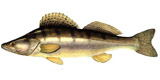
 The pike-perch belongs to the Percidae family. Its name of Lucioperca is due to its similarities with both the pike (lucius) and its cousin the perch (perca).
A lake and river fish, it is usually between 40 and 60 cm (1 1/2 to 2′) in length and between 2 and 3 kg (4.5 to 6.5 lb.) in weight, though some can weigh 10-15 kg (22-33 lb.) It is recognizable by its long body, which is slightly flared behind the head. The pike-perch is covered with small rough scales. Its elongated head has two glassy eyes and ends in a pointed snout. Its mouth is armed with toothed jaws, each with a pair of long “canines.”
The back of the pike-perch is grayish-green, and is more subdued in males during mating season. The lighter sides have 8-12 black stripes, though they are less well-defined than those of the perch. The belly is yellowish-white. The dorsal and caudal fins are marked with little black spots.
- Country of origin: Kazachstan
- Sizes: 40/70; 70/120; 120/170; 170/230; 230/300; 300/500; 500/800; 800+