
Author: Paklydes

Mackerel
A primarily coastal pelagic species, to a lesser extent epipelagie or mesopelagic over the Continental slope, occurring from the surface to about 250 or 300 m depth. Seasonal migrations may be very extended, the fish in the northern hemisphere moving further northward with increased summer temperatures, and southwards for overwintering and spawning. The reverse pattern […]
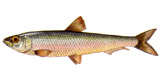
Sardinella
Schools in the coastal waters from inshore to edge of shelf. Prefers clear water with salt in minimum temperatures below 24°C. Juveniles tend to stay in nursery areas, but on maturity rejoin adult stocks offshore. Strongly migratory, often rising to surface at night and dispersing. Feeds mainly on zooplankton, especially copepods. Juveniles take phytoplankton. Breeds […]
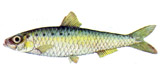
Sardine
Max length : 27.5 cm SL male common length : 20.0 cm SL male. Form schools, usually at depths of 25 to 55 or even 100 m by day, rising to 10 to 35 m at night. Feed mainly on planktonic crustaceans, also on larger organisms. Spawn in batches, in the open sea or near […]
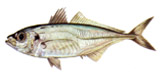
Horse Mackerel
The Atlantic horse mackerel, Trachurus trachurus is a species of mackerel in the family Carangidae. It gets its common name from the legend that other smaller species of fish could ride on the back of it over great distances. Other common names include common scad, maasbanker, pollock, scad, saurel, rough scad. The Atlantic horse mackerel […]
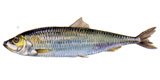
Herring
Herring is an oily fish of the genus Clupea, found in the shallow, temperate waters of the North Pacific and the North Atlantic oceans, including the Baltic Sea. Two species of Clupea are recognized, the Atlantic herring (Clupea harengus) and the Pacific herring (Clupea pallasii), each which may be divided into subspecies. Herrings are forage […]
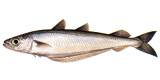
Blue Whiting
Colour: blue-grey on the back, paler on the sides, shading to white on the belly. Sometimes a small dark blotch at base of pectoral fin. Oceanic and benthopelagic over the continental slope and shelffrom 150 to more than 1000 m, but more common at 300-400 m. Migrates in summer, after spawning, to the North (Faeroes, […]

Atlantic Mackerel
An epipelagic and mesodemersal species, most abundant in cold and temperate, shelf areas. Atlantic mackerel school by size. They overwinter in deeper waters but move closer to shore in spring when water temperatures range between 11° and 14° C. Two separate populations with little or no interchange seem to exist in the northwestern and northeastern […]
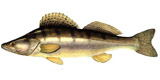
Pike Perch
The pike-perch belongs to the Percidae family. Its name of Lucioperca is due to its similarities with both the pike (lucius) and its cousin the perch (perca). A lake and river fish, it is usually between 40 and 60 cm (1 1/2 to 2′) in length and between 2 and 3 kg (4.5 to 6.5 […]