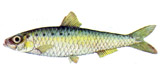
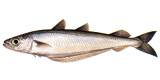
 Colour: blue-grey on the back, paler on the sides, shading to white on the belly. Sometimes a small dark blotch at base of pectoral fin.
Oceanic and benthopelagic over the continental slope and shelffrom 150 to more than 1000 m, but more common at 300-400 m. Migrates in summer, after spawning, to the North (Faeroes, E. Iceland and Norway) and back to the spawning areas in January-February. Also makes daily vertical migrations: surface waters at night and near the bottom during the day. Reaches its first maturity at 3 years of age. Sex ratio varies geographically: 35% males – 65 females in Iceland; 46% males – 54% females in the Faeroes; 41% males – 59 females in W. Scotland; 42% males – 58% females in the Tuscan archipelago. From February to June, 6 000 to 150 000 eggs are laid, the major spawning grounds being the western UK Islands, but also off Portugal, Bay of Biscay, Faeroes, Norway and Iceland, above the continental shelf. Growth is fast: 1 year = 16 cm; 5 years = 27 to 29 cm; 10 years = 29 to 34 cm. Females are usually larger than males. Maximum age is 20 years (45 cm).Feeds mostly on small crustaceans, also prey on small fish and cephalopods.
- Trim: HGT (Headed, Gutted, Tail off)
- Freezing: ship frozen / land factory frozen